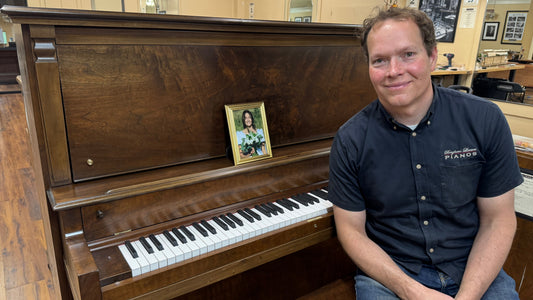

1927 Kurtzmann Piano—Rebuilt with Glass & LED Lights!
Brigham Larson PianosEvery once in a while, a piano restoration comes through our shop that is completely different from anything we’ve done before.
This turn-of-the-century 1927 Kurtzmann upright piano is definitely one of those projects.
We completely rebuilt and refinished this piano from the inside out—but the feature that immediately grabs your attention is the front.
Instead of hiding all of that restoration work behind a traditional wood panel, the family requested a custom idea to Brigham:
Why not put it behind glass?
And I have to say, it turned out incredibly cool.


Putting the Restoration on Display
The family's vision was to replace the traditional upper front panel with a custom piece of ¼-inch glass.
We had to create the panel so that everything lined up correctly and it could function just like the original front panel.
But once it was installed, something became immediately obvious:
You could finally see all the work that normally gets hidden inside a restored piano.
That's one of the funny things about piano restoration.
We can spend an enormous amount of time rebuilding the interior of a piano, replacing worn components and making everything beautiful again. Then we put the cabinet panels back on—and most of that work disappears.
Not on this Kurtzmann.

Completely Rebuilt Inside
Behind the glass, you can see the results of the restoration every time you walk past the piano.
We installed new tuning pins and strings, along with new hammers, shanks, hammer butts and dampers.
The felt, leather and cloth components were renewed. The bridges and soundboard received the restoration work they needed, including a new cap on the bass bridge and soundboard repairs.
You can even see the beautiful refinished plate with its automotive-quality finish shining through the glass.
The cabinetry was refinished as well, bringing the exterior back to life to match all of the work happening inside.
And now, instead of having to remove panels to appreciate those details, they're part of the piano's appearance.
But we weren't quite finished.
Then We Added the Lights
This is where it gets really fun.
The family also wanted LED lighting inside the piano.
With the glass front installed, the lights illuminate the plate, strings, hammers and action. Turn the room lights down and the entire inside of the piano glows.
You can even watch the action working while someone plays.
The lighting can change colors and use different effects, although I think simply illuminating the beautiful interior is probably my favorite way to use it.
It's almost like putting the mechanics of the piano on exhibit.
And because this is a real acoustic piano—not a decorative piece—everything you're watching through that glass is actually producing the music you're hearing.


More Than a Showpiece
As fun as the glass and lights are, none of that would mean very much if the piano didn't play beautifully.
That's still the most important part.
After the structural, action and tonal work was completed, this Kurtzmann came back to life as a musical instrument.
The soundboard repairs restored tension to the wood, the action was rebuilt, and the instrument was carefully brought back into playing condition.
The result is a piano that looks completely unique, sounds beautiful, and feels personal to its family.
That's what I love most about this project.


Historically Faithful Restoration & Custom Features
There is certainly a place for historically faithful piano restoration, and we do a lot of that work.
But restoration can also be an opportunity to take something and make it uniquely yours.
We've worked with families who want to preserve every possible detail of an heirloom piano, and we've worked with families who want different finishes, modern player systems, custom components or other creative touches.
In this case, a turn-of-the-century Kurtzmann became a glass-front, illuminated acoustic piano that proudly shows off the craftsmanship inside.
Almost 100 years after it was built, it's certainly not finished making music.
And that's exactly what a great restoration should accomplish.